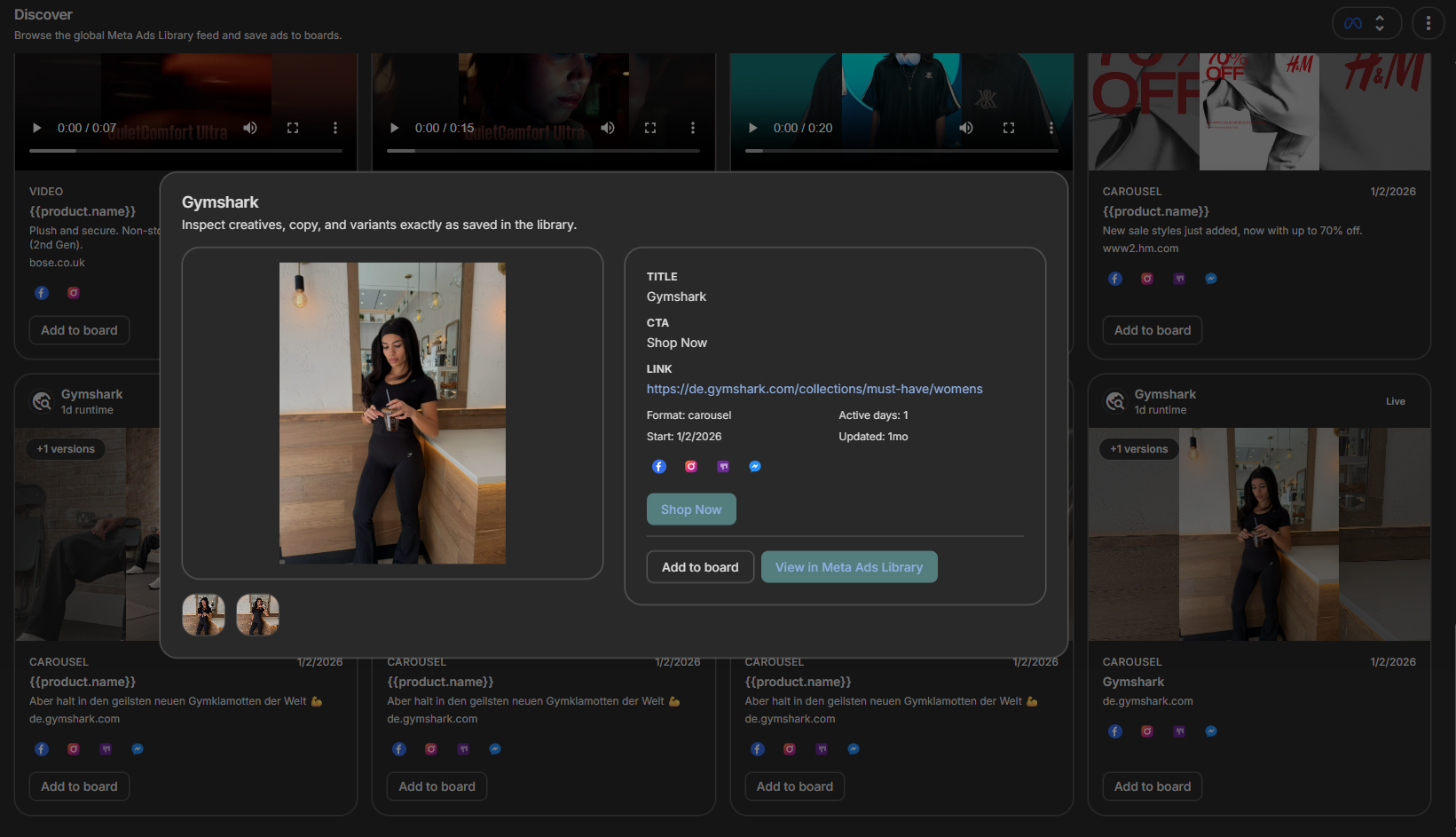
Competitor Ad Monitoring: How to Track Every Move Without Manually Checking the Ads Library
Your competitors are launching new campaigns, testing new angles, and shifting strategies every week. If you are checking the Ads Library manually once a month, you are already behind.
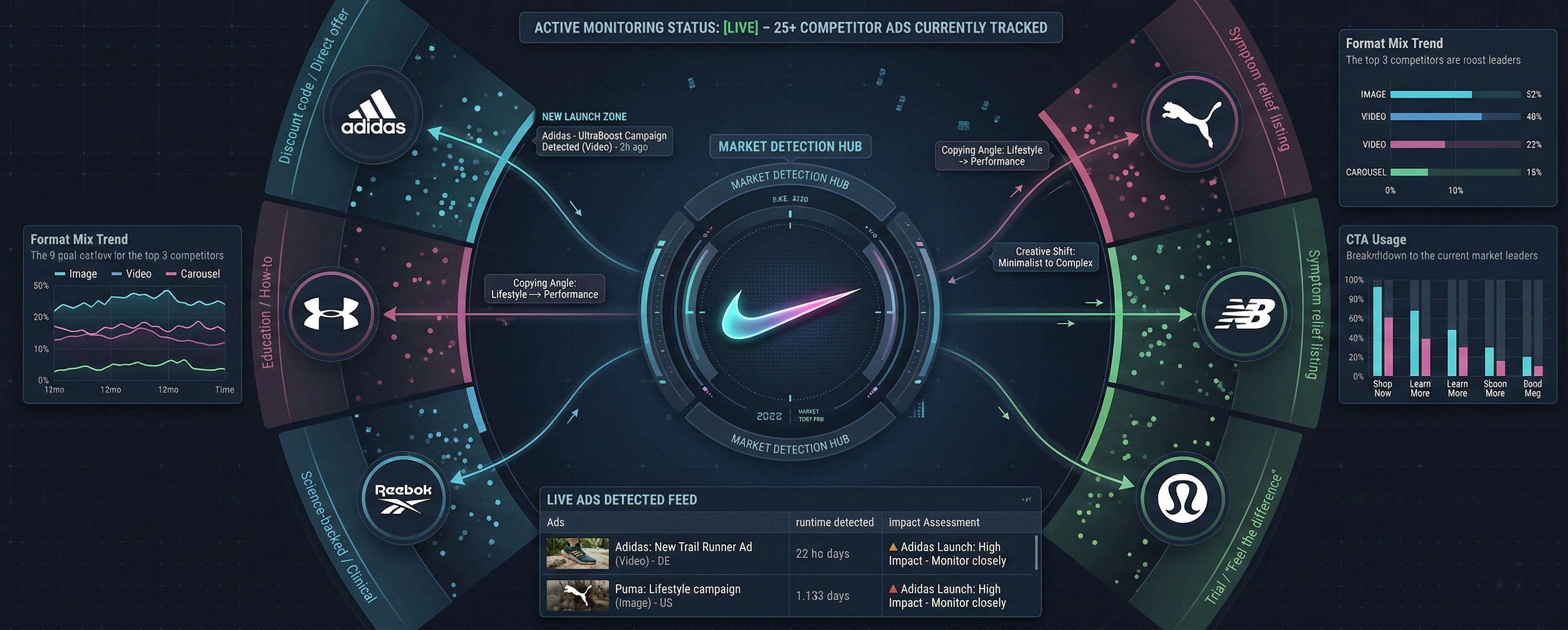
Someone asks, "What are our competitors running right now?" Then everyone looks at each other. Someone volunteers to check. They open Meta Ads Library, scroll through a wall of ads, take some screenshots, paste them into Slack, and say "looks like they are doing a lot of UGC stuff now."
That is not competitive intelligence. That is a guess wrapped in a screenshot.
The difference between brands that react to competitors and brands that anticipate them is the system. Everyone knows the Ads Library exists. The brands that win have a process for tracking competitor creative consistently and turning patterns into strategic decisions.
The Cost of Being Reactive
When you do not know what your competitors are running, you lose context in three critical ways.
You miss market shifts. Industries move in waves. Your category might be shifting from authority-led messaging to UGC authenticity. If you only check the landscape quarterly, you are always one cycle behind.
You miss validated angles. A competitor ad running for 200+ days is not a test --- it is a proven winner. That longevity tells you the angle works and the economics support continued spend. Ignoring these signals means ignoring one of the strongest market signals available.
You miss gaps. Competitive analysis is not just about what others are doing --- it is about what they are not doing. If everyone runs video but nobody uses carousel, that is whitespace. Gaps are where differentiation lives.
Why Manual Checking Does Not Scale
The Meta Ads Library is a public resource, but it is almost useless without a system. There is no trending or comparison view. No way to track longevity without manual math. No classification by angle, format, or CTA. No alerting when a competitor launches something new. Every visit is a snapshot with no context.
What a Real Monitoring System Looks Like
A competitive ad monitoring system does five things:
1. Continuous Tracking. Monitor competitors' Ads Library presence on a set schedule. When new ads appear, you know. When ads disappear, you know.
2. Longevity Analysis. Tag every ad with its runtime. An ad running 14 days is a test. An ad running 90 days is a validated performer. An ad running 600+ days is a pillar of that brand's strategy.
| Runtime Bucket | Count | What It Means | |---|---|---| | 0-30 days | 8 ads | Active tests, still validating | | 31-90 days | 12 ads | Emerging winners, worth watching | | 91-180 days | 6 ads | Validated performers | | 180+ days | 4 ads | Pillar creative, proven at scale |
3. Creative Classification. Classify every ad by angle (social proof, pain point, curiosity), format (image, video, carousel), CTA, platform, and offer type. This turns a wall of ads into a structured dataset.
4. Trend Detection. Over time, see how strategy evolves. Are they shifting from image to video? Moving from discounts to education-first?
5. Adaptation Ideas (Not Copies). The output should never be "let us copy that ad." It should be creative directions inspired by competitive patterns but filtered through your own brand positioning.
What This Looks Like With Glued MCP
Using Glued's MCP API and the Competitor Radar skill, this entire monitoring workflow runs automatically. In a recent scan of 30 ads across a skincare keyword over a 14-day window, the system classified every ad by format, CTA, angle, and runtime --- then surfaced actionable patterns:
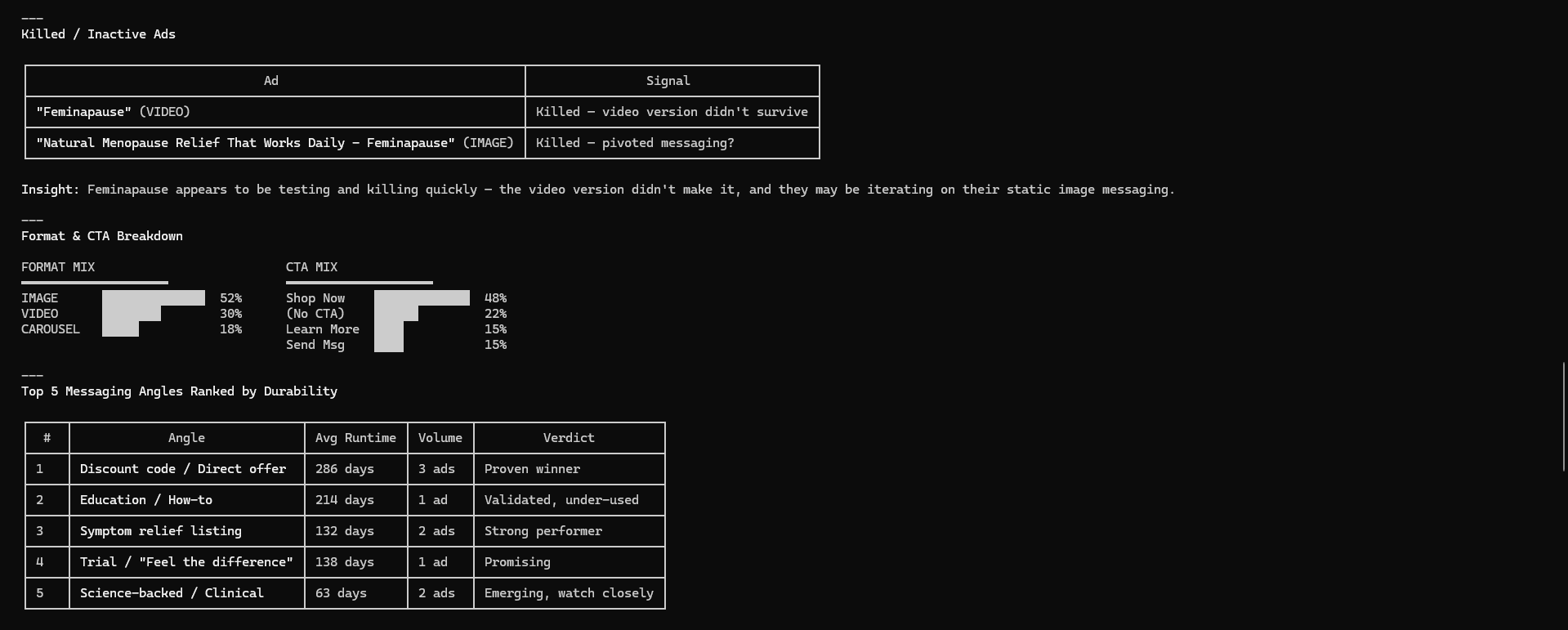
The analysis revealed: 57% video format dominance, 70% "Shop Now" CTA usage, four pillar ads running 676+ days, and a clear market shift toward UGC-style authenticity in newer creatives. It also identified strategic gaps --- almost no carousel format, no fear-based framing, zero Instagram-only placement --- each representing whitespace opportunities.
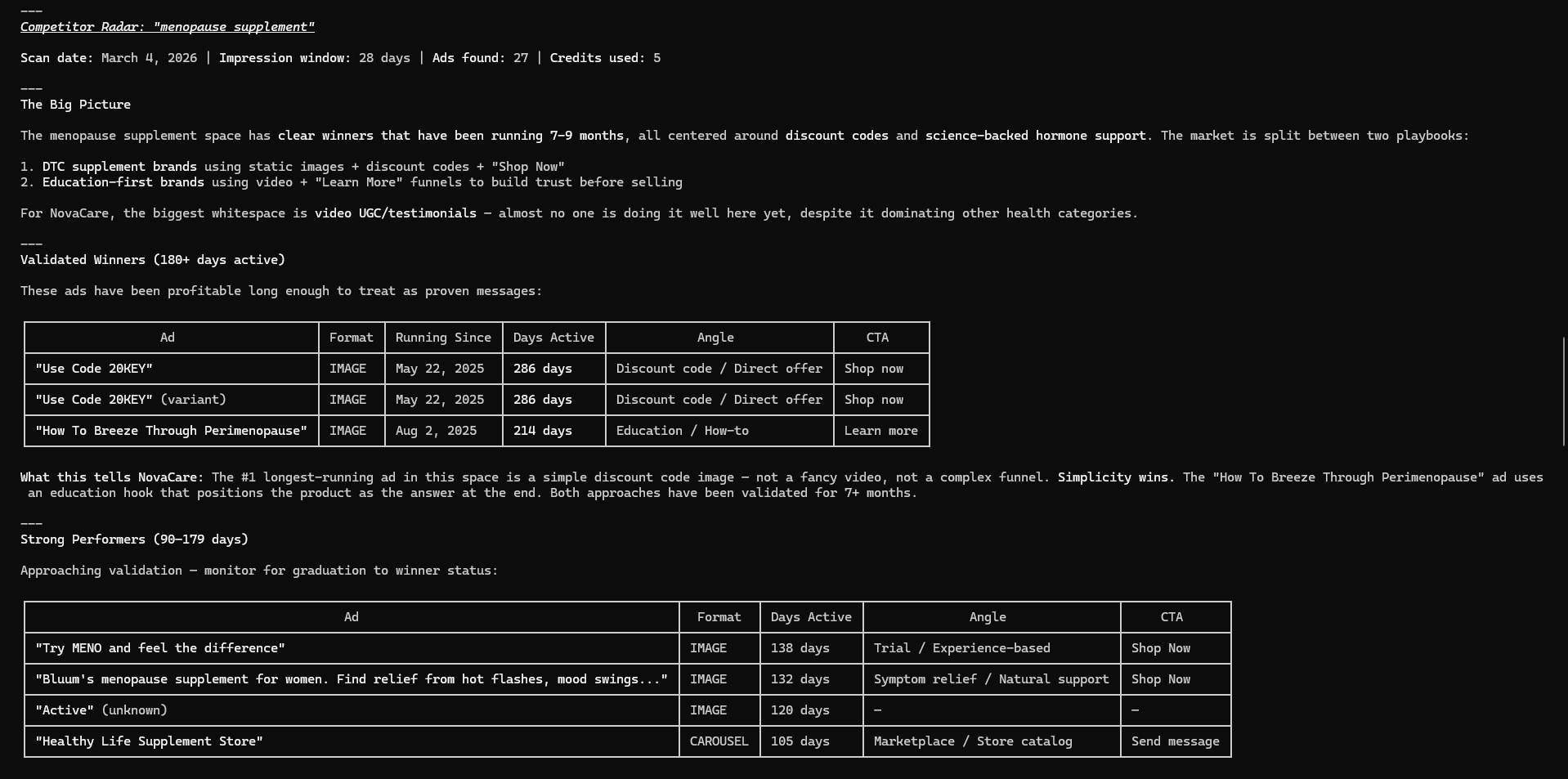
A Real-World Example: What the Data Reveals
The four ads running 180+ days are the most important ones in the entire set. They represent angles and formats that have survived competitive pressure, audience fatigue, and algorithm changes. Study those first.
Meanwhile, the newest ads (under 60 days) skew heavily toward UGC-style authenticity and education-first angles. The market is moving away from polished authority creative toward raw, relatable content. Brands that recognized this shift six months ago are ahead.
Common Monitoring Mistakes
Monitoring too many competitors. Pick three to five direct competitors and monitor them deeply. Twenty brands superficially gives you noise, not insight.
Focusing on creative, ignoring strategy. The strategic patterns --- format preferences, CTA distribution, angle rotation, testing cadence --- are what inform your decisions.
Checking reactively instead of proactively. A monthly deep-dive beats a quarterly panic check. Weekly beats monthly. Automated daily tracking is best.
Copying instead of adapting. Never replicate a competitor's creative verbatim. Use competitive data to identify what works in your market, then build your own version.
Connecting Monitoring to Strategy
Creative briefs. Monthly competitive analysis should produce two to three brief ideas. "Competitor X has been running social proof for 200 days. We should test our version."
Testing priorities. When three competitors all start testing carousel ads the same month, carousel is worth investigating.
Positioning decisions. When you can see every competitor's messaging mapped out, you can differentiate deliberately. If everyone leads with price, lead with quality.
Ready to automate your competitive monitoring? Glued tracks competitors' Meta Ads Library presence automatically, with scheduled Slack reports, runtime tracking, and one-click saving to inspiration boards. The MCP API enables AI-powered competitive analysis that classifies, trends, and surfaces gaps. Start your free trial at glued.me and never miss a competitor move again.